

2026-10-20 10:00 AM ET — Design note (the designer)
Card-edge connectors/cards may use a 3D-printed skeleton for standardized mounting to the enclosure (pairs with queued corner drills on card-edge boards).
 OSSO
New in this snapshot: 2 drawings, 0 STEP files, 1 documents/media.
Card-edge connectors/cards may use a 3D-printed skeleton for standardized mounting to the enclosure (pairs with queued corner drills on card-edge boards).
Placement/routing code test harnesses: use known, tested PCBs with full designs as references; the harness attempts to replicate each as an OSSO stack.
Fan-favorite reference test: Commodore 64 motherboard replica (the designer's first computer). Starter harness candidates: Ben Eater 6502, RC2014 (Z80). Also considered: Apple II, ZX Spectrum (Harlequin). Repo links unverified.
the designer approved this at 10:45 AM ET.
Manufacturing from blank to object per spec (spec definition/checking deferred). The "machine" = a cell with the humanoid operator (the designer as prototype) plus stations within easy reach and supporting operations. Draft stations: 1 Kitting, 2 Laser ablation, 3 Clean/inspect, 4 Paste+SMT placement, 5 Reflow, 6 TH/selective (dip pot), 7 Companion/card prep, 8 Stacking, 9 Test, 10 Enclosure/finish. Support: fume/vent, ESD, tooling storage, 3D printer, parts storage, rework, spec/traveler display. Layout idea: U/L cell, dirty/hot vs clean sides. Open: seated/standing, footprint, laser in-cell or separate.
Cell is a C shape for a standing operator: no lateral movement, every operation within reach (turn at the waist only). Planning numbers (to verify): ~500–600 mm comfortable reach, inner C radius ~0.6 m, counter at elbow height ~950–1050 mm, tall tools on outer ring/upper shelf, kitting/parts below counter.
Every machine (laser, reflow, dip pot, pick-and-place, printer, test) is built into the C cell, within the standing operator's reach. No separate rooms or remote tools. Implies compact, cell-integrated tools with built-in fume extraction and enclosures for the hot/laser stations.
First operator is a human, so the cell is human-friendly: safety (source fume extraction, laser enclosure + interlock, hot-surface guarding, e-stop, fire safety), ergonomics (standing primary with optional bench chair / sit-stand, adjustable heights, anti-fatigue mat), magnification (magnifier/stereo microscope at fine stations), lighting (even, glare-free task lighting). Human-only provisions may be removed later for a humanoid; for now human-friendly.
Maximize items/storage within reach, like an organ player: tiered vertical layers around one position. Upper tiers: angled bins/tool racks following the C; main tier: work surface + machine bays at elbow height; lower: shallow pull-out drawers (kitting/fixtures); foot pedals for hands-free actions (vacuum pickup, reflow start, extractor). Placement by frequency of use (most used front-centre at elbow height).
No part conveyance in the cell. The operator moves the part between operations to reduce clutter in the mechanism. Implies: each station has a clear landing/staging spot and a common, repeatable board nest/fixture interface so the board registers the same way at every station.
Every machine has a dedicated jig for repeatable operations. Jigs share one board datum (tooling holes + fiducials on the 140 mm blank) so the board registers identically at each station; jigs keyed/poka-yoke, 3D-printable in the cell. Ties to the no-conveyance common nest rule.
Humans make errors, so every operation has poka-yoke (keyed jigs, board presence/orientation sensing, interlocks that only allow start with correct jig + board seated) and a digital display at each machine with operator instructions driven by the spec/traveler. The cell is self-operating: machines run their operations automatically; the human only performs transport steps between stations.
Station physical placement implies NO sequence (no top-to-bottom/left-to-right order). Process order is shown by the digital display at each machine indicating what is next. Displays are e-watch sized (~1.5–2 in). Placement is then free to optimize reach, frequency and ventilation; sequence can vary per spec. Suggestion (open): next station highlights itself (flashing display or light ring) for at-a-glance guidance.
Accepted: the next station highlights itself (light ring/display), like a theater program cueing the next scene. Moves from open suggestion to decision.
Any machine requiring an interlock is tied to the process sequence: it stays locked and unlocks only when its step is the current required step. Out-of-sequence access is blocked (poka-yoke at the cell level). Open follow-ups: e-stop always active independent of sequence; keyed maintenance/override mode for cleaning, jams and service.
E-stop is always engaged/active, independent of the sequence. Faults and e-stop trigger safety rollbacks to a defined safe state, and restart requires a defined reset sequence before resuming. (Keyed maintenance mode is still an open item.)
An inspection step follows operations in the sequence: the operator brings the part to the inspection station (jigged), where it gets magnification and image capture, AI interpretation, and an operator decision (pass / rework / scrap). Images and decisions are logged to the traveler (builds a dataset for future checks). Now: visual inspection with AI interpretation; more sophisticated checks later.
Revises the earlier "no lateral movement" rule: operator lateral movement of up to ±1 m is OK, to keep the cell from getting cramped. Usable span ~2 m plus arm reach each side; C shape and standing position remain.
The outside of the C is fully clad in the concept, so external operations cannot interfere; all access is from the inside, operator position. (Service access, exhaust and utility penetrations to be planned through the cladding.)
The C may close around until only a door-width opening remains for operator entry; no physical door is required.
Cell height is about door height (~2.0–2.1 m). A closing brace/header spans above the entry opening for structural strength, closing the ring.
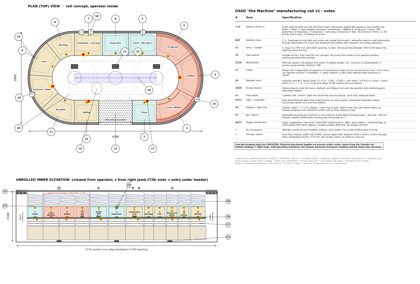
drawings/osso_machine_cell_v1.png/.pdf (script osso_machine_cell_v1.py): concept only, no CAD. Plan view + unrolled inner elevation + notes. Concept values: inner floor stadium 2200 straight + R600 ends (operator ±1 m), counter depth 600, cladding 50 → footprint 4700 x 2500 x 2100 H; 900 entry with header 1950–2100; developed counter ~7.27 m. Stations: hot zone right end (laser enclosed/interlocked, reflow, dip pot, shared hood + exhaust EX); clean front-right; paste/SMT, inspection (back centre), companion prep on the back; stacking, test, enclosure/finish, 3D printer on the left end; kitting front-left at entry. 6 e-stops, 3 pedals, display + light ring + jig on each station, organ tiers (bins 1500–2000, surface 1000, drawers 650–950). Penetrations (EX/U/D/S) generic.
Blanks, companions and cards are bought-in pre-plated fab stock (PTH/vias, ENIG, hard-gold bevelled fingers, routed outlines/key slots/tooling holes). The cell does personalisation (laser) and assembly. Note: the mains PSU card test needs an isolated, guarded fixture (possibly hipot) with its own interlock and shielding at test station 9.
Solder paste is applied by an automated XYZ dispenser (jet/auger) driven directly from the spec paste layer. No stencils are produced. Open: fine-pitch support level; possible shared gantry with pick-and-place.
Locked: 0402 is the smallest supported package for now. A jet dispensing head is required on the shared gantry. Still no stencils. Anything smaller than 0402 goes on an externally fabricated companion board.
Frozen to versions/v9_2026-10-20 + OSSO_v9_2026-10-20.tar.gz. Since v8: card-edge design notes, test harness (C64 fan favorite), docs website, Machine cell exploration and concept drawing v1, paste strategy (XYZ jet dispense on shared custom gantry, 0402 min, no stencils), blanks bought-in.